

The Great White Heron: A separate species or simply a color morph?
Even the experts disagree! In this post, we’ll discuss the various current taxonomic theories about this enigmatic heron.
Posted July 9, 2025
The Great White Heron, with its regal posture and ghostly white plumage, is one of the most striking birds of the American tropics.
Most commonly found in the coastal wetlands of southern Florida and the Florida Keys, this elegant bird is often mistaken for a Great Egret (Ardea alba) by the untrained eye. But a closer look reveals a far more intriguing story—one that continues to puzzle ornithologists and spark debate in taxonomic circles.
A Color Morph or a Distinct Species?
Traditionally, the Great White Heron has been considered a color morph of the Great Blue Heron (Ardea herodias), the familiar, blue-gray wader found across much of North America. In this interpretation, the Great White Heron is simply a white-feathered variation, officially recognized by the American Ornithological Society (AOS) as Ardea herodias occidentalis, a subspecies of the Great Blue.
However, not all authorities agree. Some, including BirdLife International and the IOC World Bird List, argue that the Great White Heron is distinct enough to warrant its own species status: Ardea occidentalis. This more elevated classification is based on a combination of morphological, ecological, and behavioral differences.
What Makes It Different?
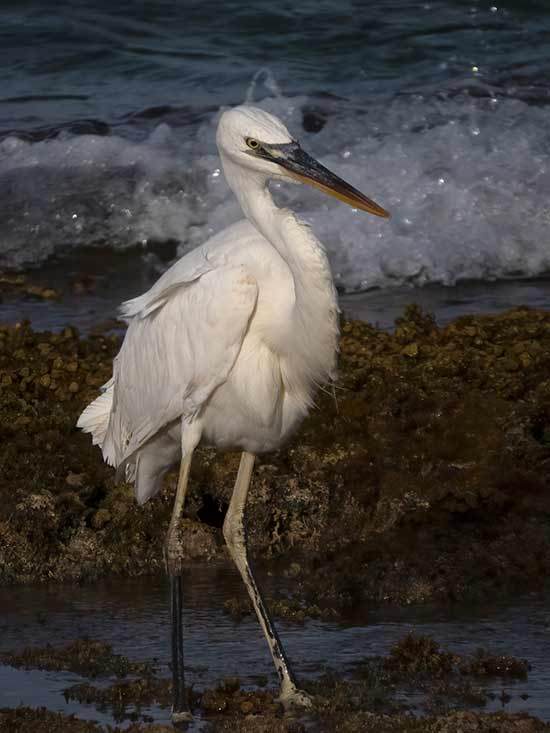
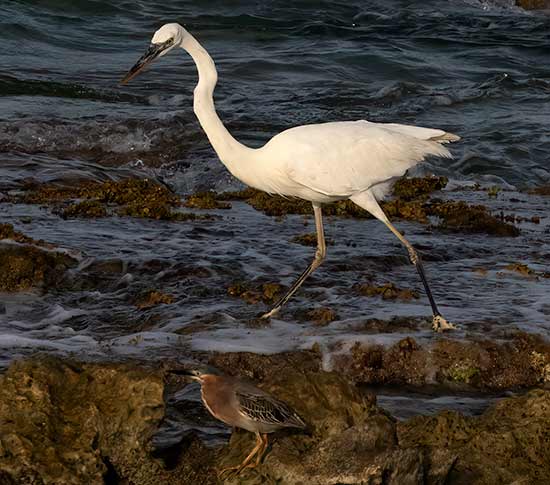
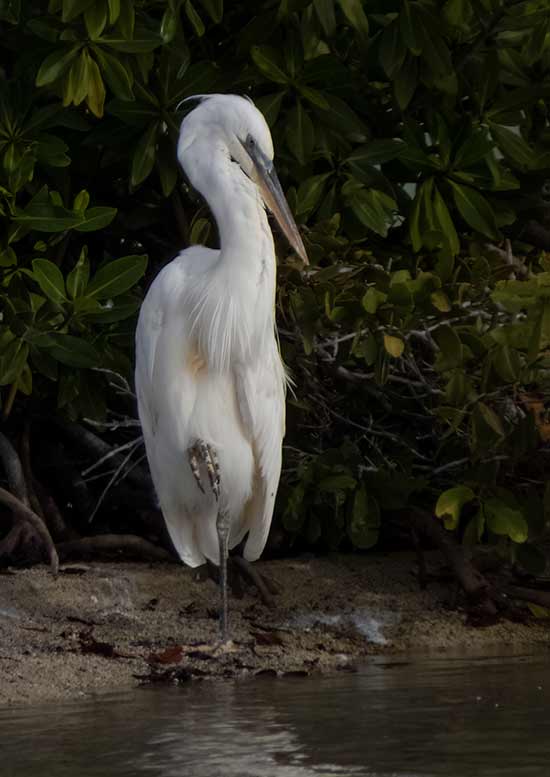
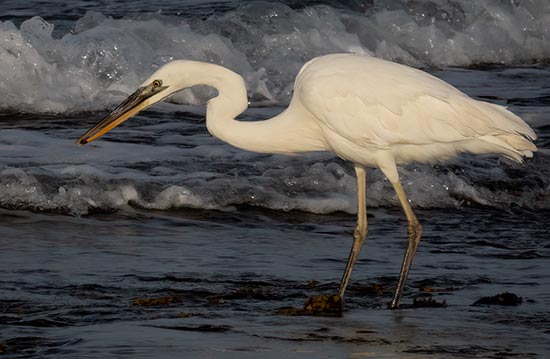
Beyond its pure white plumage, the Great White Heron exhibits a number of physical and ecological traits that set it apart from its more common, blue-colored relatives. It has a notably heavier and longer bill, a slightly bulkier body, and a preference for saline habitats such as coastal lagoons, mangrove forests, and tidal flats. While Great Blue Herons are more associated with freshwater wetlands (although here on Bonaire, we see them both in saline or fresh water environments), the Great White Heron seems to thrive in saltier environments—another factor suggesting ecological divergence.
These differences may not seem dramatic at first glance, but in the world of avian taxonomy, even subtle distinctions can play a critical role in determining species boundaries. The debate over whether these herons represent two ends of a spectrum or separate evolutionary paths has been ongoing for decades.
A Rare Visitor Turned Possible Resident
Though the Great White Heron’s primary range is centered in Florida and the lower Florida Keys, sightings have been occasionally recorded outside this core area, including in Cuba and several nearby Caribbean islands. One such location is Bonaire, located further away in the southern Caribbean, which has hosted occasional appearances of the bird.
The first confirmed sighting of a Great White Heron on Bonaire occurred in 1998, as documented by K.H. Voous in his Atlas of the Birds of the Netherlands Antilles (2001). Additional records followed in later years, including in the Checklist of the Birds of Aruba, Curaçao, and Bonaire by Prins et al. (2009). More recently, starting in 2016, an individual Great White Heron has been seen on Bonaire fairly regularly, with observations continuing to the present day.
Intriguingly, the bird appears to have a year-round presence on the island, moving between the northern and southern ends rather than engaging in long-distance seasonal migration like many Great Blue Herons. This pattern raises the possibility that the Bonaire bird has become a resident.
Implications for Science and Conservation
Whether ultimately recognized as a distinct species or retained as a color morph, the Great White Heron offers valuable insights into island biogeography, speciation, and the challenges of avian classification. Its isolated populations, ecological specialization, and limited range make it a species—or subspecies—of particular interest to conservationists, especially in the face of habitat loss and rising sea levels that threaten coastal ecosystems.
Here on Bonaire, the continuing presence of the Great White Heron is just one more example of the island’s rich and often surprising avifauna. It also serves as a reminder that even in the well-studied world of birds, mysteries remain—and that nature is often more nuanced and dynamic than our taxonomic labels suggest.
(Images courtesy of the author.)
References
- Voous, K.H. (2001). Atlas of the Birds of the Netherlands Antilles.
- Prins, T.G., et al. (2009). Checklist of the Birds of Aruba, Curaçao, and Bonaire, South Caribbean.
- McGuire, M.T. (2002). “Geographic Variation and Taxonomy of the Great White Heron,” The Auk 119(3): 649–664.
- American Ornithological Society. (2023). Checklist of North American Birds.
- BirdLife International. (2024). Species factsheet: Ardea occidentalis.

Sign up to receive notifications when a new article is posted.
About the author:
 Susan has been living on Bonaire for over 30 years. She is a certified bird guide, as well as a topside and underwater photographer. She is a 2016 graduate of the Caribbean Birding Trail Interpretive Guide Course conducted by BirdsCaribbean.
Get in touch with Susan
Contact Susan via email, Facebook Messenger, call Susan or use the online form below.
If you have any questions about your Bonaire birding tour, feel free to contact Susan for answers. She is always willing to go into more detail about routes or the best times for a tour based on your personal preferences. Tours can be tailored to your interests, whether that be birds, photography, or both!
It is also a good idea to do some homework on the birds of Bonaire before you come. Knowing a little about the birds you might encounter on your tour will make your experience even more enjoyable!
Be sure to check out these resources for birding on Bonaire. Also, reading the Bird Blog will introduce you to the birds that might be observed on Bonaire.
Get In Touch
Get in touch with Susan to check availability for the dates you are visiting Bonaire.
Consent: By using this form you agree with the storage and handling of your data by this website.
